
Macaulay Morrison Family
The Past & Present
Neil J. Macaulay in World War II
Neil Joseph Macaulay, living on the farm in Maugham, AB alone with his mother Mary Macaulay, entered the Canadian Army on March 19th, 1942 [000004]. As he states in his testimony, “The farm was too much for me to handle and being young I wanted to join the army. John Angus came home on leave and we talked it over and decided to sell the farm” (“My History”). With his brother joining the Queen’s Own Cameron Highlanders in Ottawa and his mother moving to Hamilton to stay with Marion and Roy, the time had come to enlist.
By Matthew Rettino
%20Macaulay%20in%20Uniform_bmp.png)
Neil (“Neilie”) Macaulay in uniform
His brothers, Peter and John Angus, were both in the infantry, Peter being overseas and John Angus having remained in Canada. Angus was a sergeant in the RCAF working as an instrument maker on airplanes. Neil likely saw his brothers go off to war and wanted to follow, seeing the army as a chance to escape the farm and learn new skills. (In June, his brother Donald joined the Royal Canadian Navy Reserve.)

Jock, Wee Granny, and Neilie (Neil Macaulay) visiting on leave
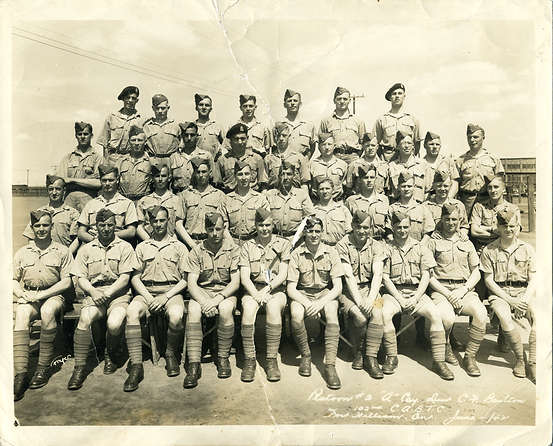
Neil was single, knew English and Gaelic, and had a Grade 8 education having worked 12 years for his mother, a widow, on the farm, which he had been doing since he turned 15. He had a few months’ experience as a hotel clerk and one month’s stint as a garage helper. Neil joined the army on his own, travelling to Winnipeg to stay with his friend Roy Ellsworth before enlisting at the Armoury. His preference was to work with wireless systems, having worked on radios as a hobby. On May 19th, he joined RCCS as a signalman and in June went for ten weeks of advanced training at the Canadian Signals Training Camp in Barriefield, near Kingston [000005]. He completed his Driver 1/C class III training on July 31st. This training prepared him to work, under supervision, on mobile construction vehicles as a fitter, or armament mechanic. Though Neil aspired to enter a wireless section, he ultimately worked on telegraph and phone lines as a driver.

Neil Macaulay in his Basic Training group
The London Blitz
Neil landed in the United Kingdom on September 1st, 1942, joining the II Canadian Corps of Signals on October 8th. He was stationed in Weybridge, 20 miles from London. Neil would often go on leave to London. These years were during the Blitz. Neil reported being caught in the street many times during bombing raids (“My History”). He would have witnessed ordinary people taking up extraordinary responsibilities in a crisis, and seen the devastation wrecked by the bombing firsthand. After the war, his son Peter Macaulay recalls Neil giving fire safety lessons as a Boy Scouts leader at Our Lady of Fatima parish, Montreal, and drawing from his first-hand experience of the Blitz.

Peter and Neil Macaulay with friends on leave
Despite these dangers, Neil found the companionship of fellow Scots. Every weekend, Neil would get a pass to stay at the MacClays’, “people Angus got to know,” presumably in London (“My History”). There, he claims to have slept in Lord Lovat’s bed—a likely reference to Simon Fraser, 15th Lord Lovat, an aristocratic military celebrity called “the most beautiful man who ever cut a throat” by Winston Churchill.
Operation Fortitude
During these years, the U.K. was waging a deception campaign against the Germans called Operation Fortitude, whose goals was to prepare the way for D-Day and prevent a repetition of the disaster at Dieppe. Neil claims to have outwitted German spies in Weybridge (“My History”). However, Ben MacIntyre challenges this picture, stating that by June 1943, Tar Robertson, master of the “Double Cross” system instrumental to the D-Day deception, believed “every single German agent in Britain was actually under his control” (16). This suggests any spies were controlled by the British.
In January 1944, II Canadian Corps Commander Lt-Gen. G.G. Simmonds, Field Marshal Montgomery, and General Eisenhower inspected the RCCS (Moir 110). Neil participated in the intensified period of training, completing his driving and waterproofing training that spring and earning a new pay rate as a tradesman.
Angus and Neil Macaulay in England during World War II
During D-Day, June 6th, 1944, Neil remained in the U.K., waiting to cross the Channel. He may have been involved in Operation Tweezer: the operation to free up two camouflage corps from the deception campaign while keeping the Germans suspicious the Allies’ main target was the Pointe de Calais instead of Normandy.
Though Neil recalls crossing on “D plus 9,” his papers state that he landed in France much later, on July 4th, almost a month after D-Day. When the day came, he recalls driving a Deuce in caravan from Weybridge to London while being strafed and bombed by the Luftwaffe:
We would stop and run for the ditch and stay until they left. Cargo ships were waiting for us at the dock so we drove right on to them. We went down into the hold [of the Earl of Montcalm] with our vehicles and stayed there for the crossing [when] the convoy lost a few ships. (“My History”; personal communication with Peter Macaulay).
Neil landed on the beach eight miles from Caen, with the crane of the Montcalm lifting each vehicle out of the hold one at a time and dropping them into the water (“My History”).

Neil Macaulay with army group
Monty’s Phone
Neil recalls installing a phone for General Montgomery shortly after landing. “You may be sure I walked out of there a very proud Canadian!” says Neil (“My History”). Hastings describes Montgomery as one who “commanded immense respect from those who served under him for his willingness to listen to them, his directness and loyalty” (32). Neil was certainly one of those soldiers whose respect he earned.
Neil may have connected the phone at Amblie, where an HQ had already been established on June 27th. However, it may have also happened at Camilly, where II Canadian Corps set up an HQ on July 6th, two days after Neil landed in France.
Laying Down the Lines
In France, Neil served as a driver in a line-laying team. Peter Macaulay recalls hearing his father speak about his wartime experience: Neil’s group would go ahead, before battle, and lay cable behind enemy lines so that when the advance happened, they had communications set up. He also spoke about laying lines on the ground and on telephone poles, while some of his friends on the poles were strafed by enemy planes and died that way (personal communication).
![[7].png](https://static.wixstatic.com/media/fd0ae4_a763caf6701b460aa9f55fe4a970d739~mv2.png/v1/fill/w_635,h_474,al_c,q_85,usm_0.66_1.00_0.01,enc_avif,quality_auto/%5B7%5D.png)
Still from British cable laying training video for signals units (courtesy YouTube, RCSigs.ca)
A training video, now stored on the RC Sigs Militaria (RCSigs.ca) YouTube channel, 1 contains a description of exactly how a British line laying unit functioned. It would have consisted of three trucks of five men per team with a motorcyclist in the lead. While we don’t know whether Neil would have driven the truck with the motorized layer or one of the building team trucks carrying spare line, he would have likely worked in a similar team.
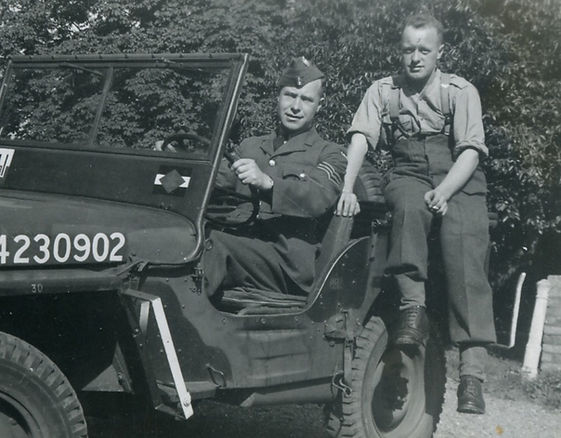
%20Macaulay%20in%20Jeep%20with%20Mates_bmp.png)
Neil Macaulay with friends in jeep
The Falaise Gap
Neil was laying phone and telegraph lines during some of the most intense fighting faced by the RCCS during the war: the advance to Caen and Falaise. Operation Atlantic, consisting of the march south and east from Caen to Falaise, was the “first real battle test for signals units” (Moir 165). German guns fronted the city of Falaise, and each time the Canadians shifted, regrouped, or attacked, Signals would have to meet their line and wireless requirements, ensuring the Corps Commander and his staff remained in communication with the two Canadian divisions. Moir explains how difficult this work was:
Initially line-laying across fields or well off roads was impeded by mines. As a result, every roadside was festooned with an unbelievable and hopelessly inextricable mess of dust-covered cable. Repair required recognition and sorting of cables, an almost impossible task. Roads in this part of Normandy generally sloped gently up or down and, in order to avoid breakage of cable, field poles were employed. Unfortunately, other units invariably tied more cables to the poles at heights from two to five feet from the ground and since vehicles could neither go under or over, they went through taking out all lines. Tanks and transporters caused endless breaks in cable. In some cases the units were responsible because cables were badly laid with no tank and vehicle crossings provided. In other cases the drivers of vehicles, especially tanks, seemed to be guilty of breaking cables from want of exercising intelligent care. (169)
With the end of Operation Totalize on August 10th, the Allies finally broke the Falaise line and opened the way to Paris. The II Canadian Corps were bound for Holland.
Peter’s Death and VE Day
We have fewer details about what Neil did in northwest Europe after these break-through operations in Normandy. However, we do know that after crossing the Seine and the Somme through August and September, the II Canadian Signals reached Ghent, Belgium. It was in Ghent that Neil acquired additional training in automotive engineering through the Canadian Legion War Services.
![[9].jpg](https://static.wixstatic.com/media/fd0ae4_f3aa1ca6e250447d95581401f472378d~mv2.jpg/v1/fill/w_635,h_474,al_c,q_80,usm_0.66_1.00_0.01,enc_avif,quality_auto/%5B9%5D.jpg)
Peter and Neil in uniform
On December 20th, 1944, Neil’s brother Peter was killed near Ravenna, Italy. By January 19th, when he wrote about it to his mother, Neil had received the news from his sisters, Cathie and Morag. “It is only when it hits one’s own family or chums one realizes what the word casualty means,” he wrote, adding that he went to church to pray and felt much better, “one in the communion of Saints. That is my faith, your faith, and Peter’s faith” (personal communication). Neil also recalls heading down to a small pub with the men at this time and hearing from the lady who owned it that her son had also been killed in Italy (“My History”).
Four months later, in May 1945, the Germans surrendered. Three days before VE day, on May 5th, Lieutenant-General Simonds accepted the surrender of General Erich von Straube and his 93,000 troops in northwest Germany (Zuehlke). The surrender was signed at the German resort town of Bad Zwischenahn near Oldenberg, a German base near a Luftwaffe airfield. The II Canadian Corps established an HQ at the resort town the next day.
Peter recalls Neil saying that the drove a German and an Allied commanding officer to a Luftwaffe base to deliver news of the unconditional surrender to German forces. Neil recalled being worried they would be shot by those who hadn’t heard the news (Peter Macaulay, personal communication). Given the presence of the airbase, it may have been at Bad Zwischenahn after the May 5th surrender.
Neil also reports that, being in Sigs, he knew about the May 8th Armistice in advance (“My History”). Neil recalls driving to Oldenberg and people shouting, “The war is over!” from the side of the road (“My History”). “It was a happy trip,” he says.

Neil received this hand-painted map by Signalman E. S. Halse showing the progress of the II Canadian Corps through England, France, and Northwestern Europe, from the original command post at Minley Manor as far as the HQ at Oldenberg, Germany and ending in Enschede, Holland. It was printed by “Alpha” in Antwerp, Belgium.
Return to Canada
Immediately after the Armistice, Neil went on sick parade due to his ulcers. However, Neil did not leave on the Lady Nelson directly from Holland as his account appears to suggest. He received 11 days of Privileged Leave to the U.K. on June 18, after which he might have remained or returned to Continental Europe. (The war records give no other confirmed date for his arrival in the U.K.)
Five months later, on November 20th, 1945, he is confirmed to be in the U.K. and was 5 placed in the No. 11 Canadian General Hospital (Blitzko, comment on “Unit identification and ‘X’ lists”), suggesting he experienced a prolonged illness. He was treated for a duodenal ulcer [000016] and had a scar on the bridge of his nose and on his right elbow [000002]. His plan was to obtain a farm under the Veterans Land Act, a Canadian law allowing veterans to acquire land for farming after their return to Canada though he ended up taking a job as a mechanic.
He was Struck from Service from the Canadian Army on December 7th. Soon after, he would have left England on the Lady Nelson bound for Halifax and taken a train to live with his mother in Calgary (at 531-13 ave. E.). During a two-hour layover in Ottawa, Neil briefly met Inez McDermid, who he’d been corresponding with throughout the war. They would later be married at Our Lady of Perpetual Help Parish in Ottawa. He received his final discharge at the Calgary Armoury on January 19th, 1946.
![[11].JPEG](https://static.wixstatic.com/media/fd0ae4_a9dcc999c1a24a0ea53d20c1bde18d74~mv2.jpeg/v1/crop/x_97,y_0,w_1266,h_885/fill/w_678,h_474,al_c,q_80,usm_0.66_1.00_0.01,enc_avif,quality_auto/%5B11%5D_JPEG.jpeg)
The telegraph received by Inez Macaulay that reported Neilie was on his way home in December 1945. They would have met on the morning of December 30th.
Bibliography
Amaron, Douglas. “Canadian Units Finally Reach End of Long Road.” Hamilton Spectator, May 7, 1945. https://www.warmuseum.ca/cwm/exhibitions/newspapers/operations/northwesteurope_e.html
Ballin, Michaela. “Simon Fraser, 15th Lord Lovat.” Historic UK. https://www.historicuk.com/HistoryUK/HistoryofBritain/Simon-Fraser-15th-Lord-Lovat/
Blitzko. “You haven’t indicated what army the list refers to – Commonwealth or US. In the Canadian Army during WW2, there were both X and Y lists used to track ‘non-effective’ personnel.” Comment on “Unit identification and “X” lists.” Narkive: Newsgroup Archive. https://soc.history.war.world-war-ii.narkive.com/T2KTpF9i/unit-identificationand-x-lists.
Canadian War Museum. “Liberation! Canada and the Netherlands, 1944–1945.”
CSC. “2nd Canadian Corps.” Canadiansoldiers.com: The Canadian soldier in the 20th century. https://www.canadiansoldiers.com/organization/fieldforces/casf/2ndcanadiancorps.htm
Hastings, Max. Overlord: D-Day and the Battle for Normandy. Simon & Schuster, 1984.
Hesketh, Roger. Fortitude: The D-Day Deception Campaign. Overlook, 2000.
“Liberation of the Netherlands.” The Canadian Encyclopedia, 30 November 2023, Historica Canada. https://www.thecanadianencyclopedia.ca/en/article/liberation-of-holland. Accessed 29 June 2025.
Macaulay, Neil (Signalman, RCCS, II Canadian Corps, World War II, N.100112). Military service files. Archives Canada. [000001–20].
MacIntyre, Ben. Double Cross: The True Story of the D-Day Spies. Broadway Books, 2012.
Moir, John S., ed. History of the Royal Canadian Corps of Signals, 1903—1961. Corps Committee, Royal Canadian Corps of Signals. Ottawa, 1962.
“MV Fitter grading structure in WW2.” WW2Talk. 17 March 2017. https://www.ww2talk.com/index.php?threads/mv-fitter-grading-structure-inww2.69321/#google_vignette.
Macaulay, Neil. “My History.” Macaulay Morrison Family: The Past & Present. https://www.macaulay-morrison.com/myhistory.
R.A.O.C. “Cable Laying with a Cable Layer Mechanical No 1.” “Training Film: Cable Laying (D.8).” RCSigs.ca, available on YouTube Originally held by Australian War Memorial F05224.
Sgmn. Halse, E. S. War Map: 2nd Canadian Corps Signals. c.1945. Alpha, Antwerp. Personal archive.
“The ‘M’ Test.” Wartimes.ca: Remembering and Researching Canada’s Military Contributions. Phil. April 17, 2018. https://wartimes.ca/forums/viewtopic.php?t=30
“Veterans’ Land Act.” The Canadian Encyclopedia.
Wikipedia. “Battle for Caen.” https://en.wikipedia.org/wiki/Battle_for_Caen ---. “Shepperton Studios.” https://en.wikipedia.org/wiki/Shepperton_Studios
“WW2 Abbreviations and Acronyms.” Researching the Lives and Records of WW2 Soldiers. https://www.researchingww2.co.uk/ww2-abbreviations-acronyms/.
Zuehlke, Mark. “Sweetest of Springs.” Legion: Canada’s Military History Magazine. May 8, 2015. https://legionmagazine.com/sweetest-of-springs/